




Table of contents
How to Estimate How Much Your Competitors Spend on PR in Life Sciences
Beth Cooper, JD/MBA, Chief Commercial Officer
Your biotech competitor appears in a major trade publication. Its CEO is quoted in an article about the future of drug development. Its Chief Medical Officer is speaking at a conference. Its latest clinical milestone is covered by several outlets, and the company seems to release a steady stream of research, interviews and contributed articles.
Meanwhile, your company is struggling to secure more than an occasional announcement.
It is reasonable to ask: How much is that competitor spending on public relations?
There is no public database that reliably reveals every company’s PR budget. Unlike paid search, where platforms such as Semrush can estimate advertising expenditures, earned media does not have a direct relationship between dollars spent and placements received.
That does not mean competitor PR spending is impossible to estimate.
A company’s communications investment leaves a trail. Media volume, share of voice, internal communications headcount, press release frequency, executive participation, outside agency involvement, clinical milestones, conference activity and public financial disclosures can all help establish a defensible range.
The objective is not to declare that a competitor spends exactly $27,500 per month. Unless you have seen its contract or internal budget, that degree of precision is not credible.
The objective is to answer a more useful question:
What level of communications infrastructure would reasonably be required to produce this volume, quality and consistency of visibility?
Why Life Sciences PR Budget Estimates Require More Than Media Counting
Estimating public relations spending is particularly complicated in biotech, pharmaceutical, medtech and life sciences markets.
A clinical-stage biotechnology company can receive a burst of coverage because it announced positive trial data, entered a major licensing agreement or received an FDA designation. A publicly traded company may operate separate corporate communications, investor relations and scientific communications programs. A commercial pharmaceutical organization may also have product communications, disease-awareness campaigns, advocacy relationships and public affairs activity.
Some of that work may be handled internally. Some may be divided among multiple agencies. Some may be supported by medical writers, regulatory counsel, market research firms, conference partners or investor relations consultants.
A media-placement count alone cannot reveal that structure.
A credible life sciences PR budget estimate must consider five different dimensions:
- The quantity of visible media activity
- The quality and strategic importance of that activity
- The internal and external personnel required to produce it
- The company’s available news, data and clinical milestones
- Additional expenditures supporting visibility
The more independent evidence you collect, the narrower and more defensible your estimate becomes.
Step 1: Define the Life Sciences Competitive Set
Begin with three to six genuine competitors.
Companies should compete for more than a broad category label. Two organizations may both describe themselves as biotechnology companies while pursuing different indications, development stages, investors and commercial partners.
A useful competitive set should overlap across several dimensions:
- Therapeutic area
- Development stage
- Technology or modality
- Target patient population
- Commercial model
- Investor audience
- Strategic partners
- Priority publications
- Conference presence
- Prospective employees
- Search and AI visibility
For a cell and gene therapy company, the appropriate media competitors might include companies pursuing similar delivery methods, manufacturing models or health system partnerships. For a health technology platform, the set might include companies selling to the same hospital executives, payers or pharmaceutical manufacturers.
Establish the geography and media market as well. A global pharmaceutical company should not be compared with a regional startup unless the analysis is intentionally limited to a specific topic.
Finally, choose a consistent timeframe.
- Three months can identify current momentum.
- Six months can reveal developing patterns.
- Twelve months provides the most reliable view of sustained PR investment.
- Twenty-four months may be useful for companies with infrequent clinical milestones.
Avoid estimating a competitor’s normal PR budget from a single month. Trial results, financing announcements, acquisitions and regulatory decisions can create temporary coverage spikes.
Step 2: Build a Life Sciences Media Activity Database
Create a spreadsheet containing every relevant article, interview, podcast, byline, announcement and speaking appearance during the analysis period.
At minimum, capture:
|
Field |
Information to Record |
|
Date |
Publication or appearance date |
|
Company |
Competitor associated with the result |
|
Outlet |
Publication, podcast or conference |
|
Headline |
Exact title |
|
URL |
Source link |
|
Coverage type |
Feature, quote, byline, mention, interview or release |
|
Topic |
Clinical, regulatory, corporate, financing or market commentary |
|
Spokesperson |
Executive or subject matter expert featured |
|
Earned or paid |
Independent coverage, sponsored content or company-owned material |
|
Original or syndicated |
Unique story or duplicated release |
|
Outlet priority |
Tier-one, industry trade, regional or low-value aggregation |
|
Weight |
Quality score applied consistently across competitors |
Media-monitoring platforms such as Muck Rack, Cision, Meltwater, Onclusive and Brandwatch can accelerate this process. For a smaller competitive set, the research can also be completed manually through Google News, publication searches, company newsrooms and conference agendas.
Use multiple searches for each company:
- Company name
- Company name + CEO
- Company name + chief medical officer
- Company name + clinical trial
- Company name + FDA
- Company name + funding
- Company name + partnership
- Company name + data
- Company name + interview
- Company name + podcast
- Company name + conference
- Company name + sponsored
Company names that overlap with common words require additional exclusions. Product names, former company names and commonly used abbreviations may also need to be included.
Step 3: Calculate Life Sciences PR Share of Voice
Share of voice measures the percentage of a defined media conversation captured by one company relative to the entire competitive set.
The basic formula is:
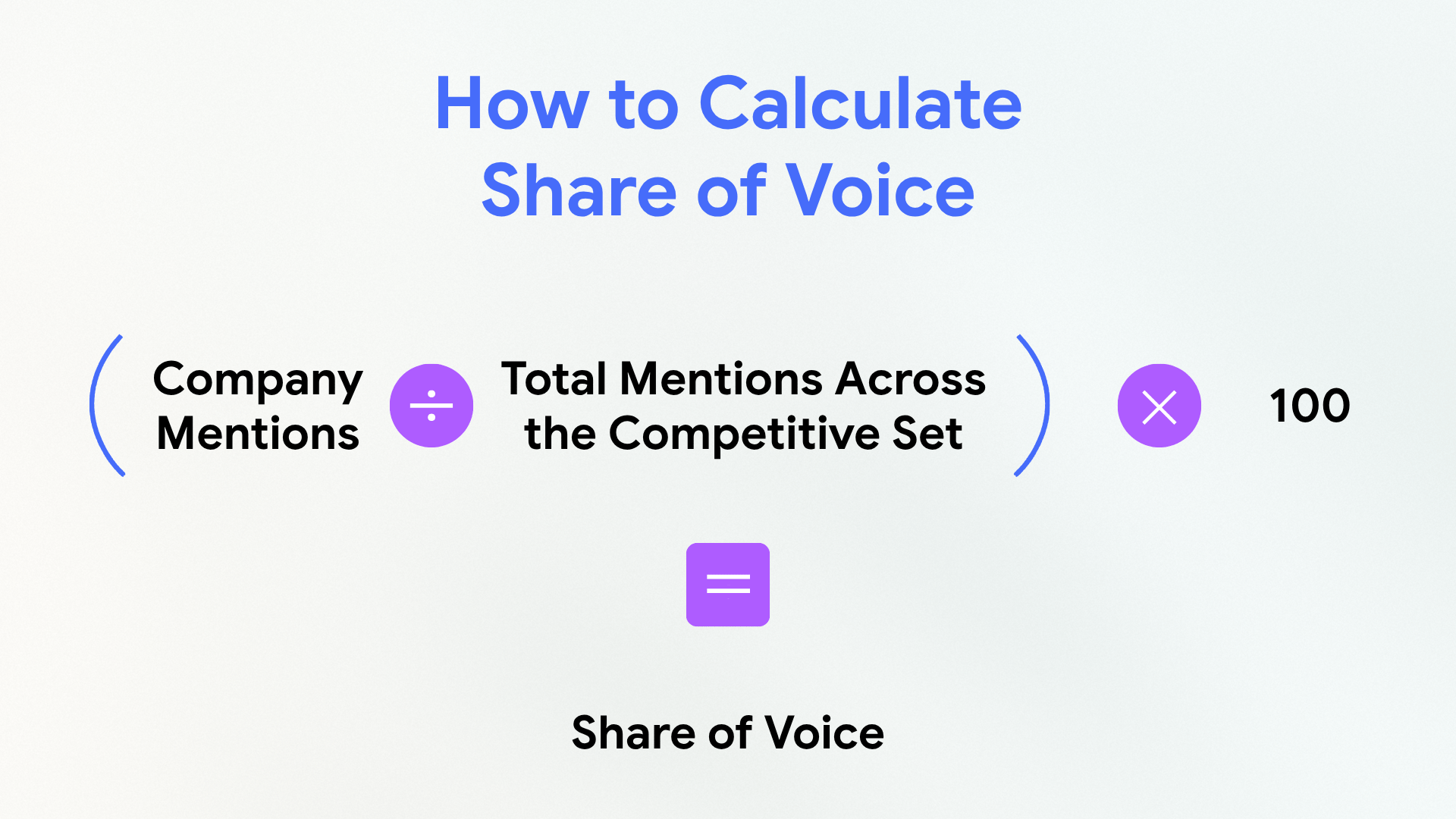
If your company receives three qualifying mentions and the competitive set receives 100 total mentions, your share of voice is 3%.
Muck Rack defines PR share of voice as a company’s portion of a defined media conversation and recommends maintaining a consistent competitor list, timeframe and measurement methodology. It also cautions that volume without context can be misleading. Outlet authority, prominence, reach and sentiment all affect the value of a mention. Read Muck Rack’s share-of-voice methodology.
Calculate at least two forms of share of voice:
Raw Media Share of Voice
Every qualifying original mention receives one count.
This answers:
How frequently is each company appearing in the conversation?
Weighted Media Share of Voice
Coverage is scored according to strategic value.
This answers:
Which company is earning the most meaningful visibility?
A practical life sciences weighting model might look like this:
|
Life Sciences Media Result |
Suggested Weight |
|
Major national feature or company profile |
8 points |
|
Major business publication feature |
7 points |
|
In-depth feature in a priority life sciences publication |
6 points |
|
Exclusive clinical, regulatory or financing story |
6 points |
|
Executive byline in a priority publication |
4 points |
|
Executive quoted as a central expert |
4 points |
|
Podcast or substantial interview |
3 points |
|
Conference speaking appearance |
3 points |
|
Meaningful company mention |
2 points |
|
Brief inclusion in an industry roundup |
1 point |
|
Original press release |
1 point |
|
Automated press release syndication |
0.1 to 0.25 points |
The exact weights can be adjusted. Consistency matters more than the particular numbers selected.
A feature in STAT, Endpoints News, Fierce Biotech, BioSpace, MedTech Dive or a highly specialized trade publication may be more commercially valuable than a passing mention in a larger general-interest outlet. Publication quality should be judged according to the audiences the company actually needs to reach.
Step 4: Separate Earned Media From Press Release Syndication
One press release can appear on dozens or hundreds of websites.
That does not mean dozens or hundreds of journalists independently decided to cover the company.
Newswire services distribute releases across broad networks and track the websites on which they appear. Cision describes PR Newswire as a distribution service that targets releases by geography, industry and topic while tracking site postings and other results. Review Cision’s description of PR Newswire distribution.
Wire distribution has legitimate value. It can provide:
- A permanent public record
- Broad announcement distribution
- Search visibility
- Investor access
- Website referral traffic
- Availability to journalists
- Regulatory or disclosure support
However, syndicated release copies must not be counted as independent earned stories.
Group identical or substantially identical headlines together. Classify them as one distributed announcement with multiple syndicated copies.
Maintain separate totals for:
- Original earned articles
- Executive quotes
- Contributed articles
- Original interviews
- Podcasts
- Press releases
- Syndicated release copies
- Sponsored articles
- Company-owned content
Without this step, a competitor that distributes frequent releases can appear to have dramatically more earned visibility than it actually does.
Step 5: Separate Life Sciences Earned Media From Sponsored Content
Life sciences companies frequently purchase conference packages, publication sponsorships, podcast appearances, newsletter placements and native articles.
Sponsored content can resemble editorial coverage. Look for labels such as:
- Sponsored
- Partner content
- Presented by
- Paid post
- Brand voice
- In collaboration with
- Supported by
- Industry perspective
The Federal Trade Commission states that native advertising may require clear and prominent disclosure when the commercial nature of the content would not otherwise be apparent. Review the FTC’s native advertising guidance.
Paid content should be documented because it reveals part of the competitor’s visibility investment. It should not be classified as earned media.
Create three distinct categories:
Earned visibilityPaid visibility
Owned visibility
A competitor may have relatively modest earned media results but a significant paid visibility program. That company could still be investing heavily, but the investment is operating differently.
Step 6: Map Clinical + Regulatory News Opportunities
Life sciences companies do not have equal access to news.
A company with three active clinical trials, an approaching data readout and several regulatory milestones has more natural media opportunities than a preclinical company with no expected data for 18 months.
Before attributing every difference in coverage to PR spending, inventory the events each competitor could reasonably publicize.
ClinicalTrials.gov can help identify:
- Trial sponsors
- Collaborators
- Study phase
- Recruitment status
- Enrollment
- Primary completion dates
- Study completion dates
- Intervention details
- Conditions being studied
- Results postings
ClinicalTrials.gov explains that organizations listed as sponsors and collaborators are considered study funders and provides definitions for trial status, sponsorship and other study elements. Review the ClinicalTrials.gov glossary.
Potential life sciences news drivers include:
- Investigational new drug application clearance
- First patient dosed
- Trial enrollment completion
- Interim data
- Topline results
- Peer-reviewed publication
- FDA designation
- New clinical collaboration
- Manufacturing milestone
- Licensing agreement
- Patent issuance
- Financing
- Leadership appointment
- Conference presentation
- Regulatory submission
- FDA approval
- Commercial launch
Build a “news opportunity index” for each company.
|
News Environment |
Typical Characteristics |
|
Limited |
Preclinical company with few visible milestones |
|
Moderate |
One active program with periodic corporate announcements |
|
Strong |
Multiple trials, frequent data, partnerships and financing activity |
|
Exceptional |
Late-stage or commercial company with regulatory, clinical and corporate news |
A competitor earning 20 stories from two major trial readouts is different from a competitor earning 20 stories without any material company announcement. The second result may indicate a stronger proactive media operation.
Step 7: Evaluate Life Sciences Communications Complexity
Life sciences PR requires more than identifying journalists and sending pitches.
Communications may require review by:
- Legal
- Regulatory affairs
- Medical affairs
- Clinical leadership
- Investor relations
- Commercial leadership
- Corporate communications
- Partner organizations
The FDA generally prohibits representing an investigational drug as safe or effective for the purpose for which it is being studied. At the same time, the regulation does not prohibit the full exchange of scientific information, including dissemination of scientific findings through scientific or general media. Review FDA’s discussion of 21 CFR 312.7.
This distinction affects how press releases, executive commentary, trial announcements and media materials are developed.
A life sciences program may therefore require:
- Scientific interviews
- Medical writing
- Claim substantiation
- Reference verification
- Fair-balance review
- Legal review
- Regulatory review
- Partner approvals
- Investor relations coordination
- Executive media preparation
Two companies may publish the same number of press releases while incurring very different costs because one operates in a much more complex regulatory environment.
Step 8: Count Active Life Sciences Subject Matter Experts
A competitor’s spokesperson bench can reveal the scale and maturity of its PR program.
A small or reactive program often depends entirely on the CEO. A more developed life sciences program typically assigns different narratives to different experts.
For example:
|
Subject Matter Expert |
Likely Topic Territory |
|
CEO |
Company vision, category direction and strategy |
|
Chief medical officer |
Clinical need, trial design and patient impact |
|
Chief scientific officer |
Mechanism, platform science and discovery |
|
Chief technology officer |
AI, data, security and technical infrastructure |
|
Chief commercial officer |
Market adoption, customer needs and commercialization |
|
Regulatory leader |
Policy, approval pathways and compliance |
|
Manufacturing leader |
Scale-up, quality and supply chain |
|
Health system or research partner |
Implementation and independent validation |
|
Patient or advocacy partner |
Lived experience and unmet need |
Each active expert requires:
- Message development
- Topic positioning
- Media-opportunity identification
- Interview scheduling
- Briefing documents
- Preparation calls
- Background research
- Follow-up
- Content development
- Approval management
Use the following directional guide:
|
Active Experts |
Likely PR Program Maturity |
|
1 |
Reactive or CEO-led program |
|
2 to 3 |
Sustained media-relations program |
|
4 to 6 |
Coordinated thought-leadership program |
|
7+ |
Enterprise or multi-agency communications operation |
This is not an absolute rule. A company may make several executives available without using them effectively. Look for actual media participation, not names listed on a leadership page.
Step 9: Estimate Internal Life Sciences PR Headcount
Search LinkedIn, leadership pages, press release contacts, archived job listings and organizational announcements.
Relevant titles include:
- Chief communications officer
- Vice president of communications
- Head of corporate communications
- Director of media relations
- Director of scientific communications
- Communications manager
- Public affairs director
- Investor relations leader
- Executive communications director
- Content + communications manager
- Patient advocacy communications director
Do not classify every marketing employee as a PR resource.
Estimate what percentage of each role is likely dedicated to external communications:
|
Role Structure |
Possible PR Allocation |
|
Dedicated media relations professional |
80% to 100% |
|
Corporate communications director |
50% to 80% |
|
Communications + content manager |
30% to 60% |
|
Marketing vice president overseeing many functions |
15% to 35% |
|
CEO or founder |
5% to 15% |
|
Scientific or medical executive |
5% to 10% |
These allocations are assumptions. Document them clearly and adjust them when job descriptions provide stronger evidence.
The U.S. Bureau of Labor Statistics reported a May 2024 median annual wage of $69,780 for public relations specialists. View the BLS public relations specialist data.
For public relations managers, the national median was $138,520. The median within professional, scientific and technical services was $168,400. View the BLS public relations manager data.
Salary is not the company’s complete employment cost. Benefits, payroll taxes, technology, recruiting, management and overhead also contribute.
A practical formula is:
Monthly Loaded Cost = Annual Salary x 1.25 to 1.4 / 12
Then multiply the result by the estimated percentage of time allocated to PR.
Internal PR Payroll Example
Assume a biotechnology company employs a communications director earning approximately $150,000.
At a 1.3 loaded-cost multiplier:
$150,000 x 1.3 = $195,000
Monthly loaded employment cost:
$195,000 / 12 = $16,250
If approximately 60% of the role supports external PR:
$16,250 x 60% = $9,750
The company’s estimated internal PR investment for that role would therefore be approximately $9,750 per month.
Repeat this calculation for each relevant employee.
Step 10: Search SEC Filings for Biotech PR Expenses
Public biotechnology and life sciences companies may disclose communications expenses in SEC filings, although PR is often combined with investor relations, consulting or general administrative costs.
Use the SEC EDGAR full-text search to search the company’s filings for terms such as:
- Public relations
- Investor relations
- Communications
- Media
- Marketing
- Professional services
- Outside consultants
- General + administrative expenses
- Conference costs
Some companies disclose specific changes.
For example, Coya Therapeutics reported that a year-over-year increase in general + administrative costs included approximately $300,000 in increased investor relations + public relations expenses. This reveals the increase, not the company’s total communications budget. View the Coya Therapeutics filing.
Serina Therapeutics reported $100,000 in investment + public relations-related expenses during a quarter associated with broader increases in general + administrative costs. View the Serina Therapeutics filing.
These examples illustrate both the value and limitations of SEC data.
A filing may reveal:
- A change in PR spending
- A one-time campaign expense
- The inclusion of PR within professional services
- An investor relations contract
- Stock issued for communications services
- A broad SG+A budget ceiling
It rarely provides a complete monthly corporate PR retainer.
Use SEC disclosures as one piece of corroborating evidence, not as the entire estimate.
Step 11: Identify Outside Life Sciences PR Support
Companies do not always publicly announce their PR agency relationships, but outside support often leaves evidence.
Look for:
- An agency email address on a press release
- An outside contact in a company newsroom
- Agency credits on award submissions
- Agency employees sharing company coverage
- Publicly announced account wins
- Communications vendors listed in SEC filings
- Consistent writing or media patterns
- Job descriptions mentioning agency management
- Conference presentations featuring company + agency representatives
If an outside contact appears on multiple releases, search the individual’s name, email domain and professional profile.
Do not estimate the retainer solely from the agency’s size or reputation. A large agency may handle a narrow project, while a smaller specialist firm may manage the entire communications function.
Estimate scope instead.
Possible scopes include:
- Press release development
- Reactive media support
- Proactive media relations
- Executive thought leadership
- Scientific communications
- Investor relations
- Corporate communications
- Crisis preparedness
- Public affairs
- Content development
- Social amplification
- Conference strategy
- Awards
- Media monitoring + reporting
The broader the visible scope, the larger the probable investment.
Step 12: Estimate the Work Behind Life Sciences Media Results
Published coverage represents only the visible output.
One executive quote may require:
- Monitoring the news cycle
- Identifying a relevant developing story
- Matching the story with the correct expert
- Drafting a point of view
- Securing executive availability
- Pitching multiple journalists
- Following up
- Preparing the spokesperson
- Coordinating legal or regulatory review
- Managing the interview
- Correcting factual information
- Amplifying the result
- Reporting the outcome
A bylined article may require topic research, publication selection, abstract development, editor outreach, subject matter expert interviews, drafting, sourcing, revisions and approvals.
A major feature may follow months or years of relationship-building.
This is why placement counts should not be converted mechanically into budget estimates. Five high-quality results may require more work than 50 automated wire pickups.
Step 13: Add Hidden Life Sciences PR Program Costs
The agency retainer and internal team are not the entire budget.
A mature life sciences PR program may also include:
Media Monitoring & Journalist Databases
These tools support media research, monitoring, competitive analysis, journalist outreach and share-of-voice reporting.
Press Release Distribution
Distribution frequency, geographic reach, word count, multimedia and targeting affect wire costs.
Original Research
A proprietary life sciences report may require:
- Research design
- Survey programming
- Respondent recruitment
- Panel costs
- Statistical analysis
- Medical or scientific review
- Writing
- Design
- Landing-page development
- Media outreach
Scientific & Medical Writing
Highly technical materials may require writers with scientific degrees, clinical expertise or experience interpreting study data.
Regulatory & Legal Review
Outside regulatory counsel, medical review and legal approval may sit outside the communications retainer.
Awards
Costs include entry fees, research, drafting, supporting evidence and deadline management.
Conferences & Speaking
Speaking opportunities may be earned, sponsored or connected to exhibit packages. Include only the communications-related portion when estimating PR spending.
Executive Media Training
A clinical-stage company preparing executives for data announcements, financing activity or regulatory milestones may conduct formal media training.
Crisis & Issues Management
Clinical holds, adverse events, litigation, data questions, cybersecurity incidents and regulatory scrutiny may require senior communications counsel without producing a high volume of visible content.
Step 14: Build a Life Sciences PR Investment Range
Once the program is mapped, assign it to a likely operating level.
The following are Sōvyn planning ranges based on program scope. They are directional estimates, not universal industry rate cards.
|
Life Sciences PR Program |
Observable Characteristics |
Estimated Total Monthly Investment |
|
Reactive Program |
Occasional releases, one spokesperson, little proactive pitching |
$10,000 to $25,000 |
|
Sustained Media Relations |
Regular outreach, monthly coverage, two to three experts, periodic bylines |
$25,000 to $50,000 |
|
Category-Building Program |
Multiple experts, proactive commentary, research, speaking + consistent coverage |
$50,000 to $100,000 |
|
Enterprise Communications |
Large internal team, multiple agencies, investor relations, public affairs + crisis support |
$100,000+ |
These estimates may include:
- Outside agency support
- Allocated internal payroll
- Media-monitoring technology
- Newswire distribution
- Research
- Scientific writing
- Awards
- Executive preparation
- Paid content
- Conference communications
- Regulatory + legal review
If you are estimating only the probable agency retainer, remove internal payroll and clearly separate pass-through expenses.
The Competitor PR Spend Formula
Use the following formula:
Estimated Monthly PR Investment =
Outside Support
+
Allocated Internal Payroll
+
Tools + Distribution
+
Program Expenses
Create low, probable and high scenarios for every component.
|
Cost Component |
Low |
Probable |
High |
|
Outside communications support |
$15,000 |
$25,000 |
$35,000 |
|
Allocated internal payroll |
$8,000 |
$14,000 |
$22,000 |
|
Tools + distribution |
$1,000 |
$3,000 |
$6,000 |
|
Scientific content + review |
$2,000 |
$6,000 |
$12,000 |
|
Research, awards + events |
$2,000 |
$7,000 |
$15,000 |
|
Total monthly investment |
$28,000 |
$55,000 |
$90,000 |
The wide range is intentional. Reduce it only when additional evidence supports greater precision.
A Hypothetical Biotech Competitor PR Spend Example
Consider a clinical-stage biotechnology company with the following visible activity over 12 months:
- 42 original earned media placements
- 185 syndicated press release copies
- Four active executive spokespeople
- Six contributed articles
- Eight podcast appearances
- Three major clinical milestones
- Four conference presentations
- One original industry survey
- An internal communications director
- A vice president overseeing investor relations
- An identifiable outside communications contact
After deduplicating wire syndication, the company averages approximately 3.5 original earned placements per month.
Its visibility is not supported by releases alone. The company has multiple experts, proactive thought leadership, conference activity and original research.
A reasonable estimate might be:
- Outside PR support: $20,000 to $35,000 per month
- Allocated internal communications payroll: $12,000 to $22,000
- Monitoring + distribution: $2,000 to $6,000
- Scientific content + review: $3,000 to $10,000
- Research, awards + events averaged monthly: $5,000 to $15,000
Estimated total PR + communications investment:
$42,000 - $88,000 per month
Because the internal team, outside support and 12 months of activity are identifiable, this estimate would receive a moderate-to-high confidence rating.
What a 0.3% Versus 11.6% PR Share-of-Voice Gap Means
Suppose your life sciences company holds 0.3% media share of voice while a competitor holds 11.6%.
The competitor’s share is approximately 38.7 times larger:
11.6 / 0.3 = 38.67
This does not prove that the competitor spends 38.7 times more on PR.
PR performance is not perfectly proportional to investment. Results can be influenced by:
- Company maturity
- Brand recognition
- Trial stage
- Quality of clinical data
- Frequency of news
- Founder profile
- Existing journalist relationships
- Market controversy
- Responsiveness of executives
- Years of accumulated authority
However, a gap of that size is unlikely to be explained by creativity alone.
It usually indicates a material difference in at least several areas:
- Communications spending
- Media-relations volume
- Executive participation
- Subject matter expert availability
- News generation
- Research
- Content production
- Distribution
- Relationship-building
- Program duration
The defensible conclusion is not:
The competitor must be spending exactly 38.7 times more.
The defensible conclusion is:
The competitor is operating at a materially higher level of communications activity, infrastructure and investment. Closing the share-of-voice gap will require a sustained program rather than an occasional campaign.
How to Score Confidence in a Competitor PR Budget Estimate
Assign one point for each evidence category you can substantiate:
- Internal communications team identified
- Outside support identified
- Twelve months of media analyzed
- Earned media separated from wire syndication
- Paid content separated from earned media
- Clinical & regulatory news environment documented
- Active subject matter experts counted
- SEC filings reviewed
- Research, awards + conference activity inventoried
- Tools or distribution activity estimated
Use the total to classify the estimate:
|
Score |
Confidence Level |
|
8 to 10 |
High-confidence range |
|
5 to 7 |
Moderate-confidence range |
|
0 to 4 |
Low-confidence range |
Even a high-confidence estimate remains a range.
Common Life Sciences PR Budget Estimation Mistakes
Counting Every Press Release Pickup as Earned Media
One release syndicated to 100 sites is still one release.
Treating Sponsored Content as Independent Journalism
Paid articles reveal investment but should not be credited as earned coverage.
Ignoring Clinical & Regulatory News Volume
A company approaching several trial milestones naturally has more opportunities than one in early preclinical development.
Ignoring Internal Communications Payroll
A competitor with a communications director, media manager and investor relations leader may already be investing tens of thousands of dollars per month before agency costs.
Assuming Every Marketing Employee Supports PR
Demand generation, product marketing and sales enablement should not automatically be classified as media-relations spending.
Combining PR & Investor Relations Without Explanation
Public life sciences companies frequently coordinate these functions, but they serve different audiences and may have separate budgets.
Estimating From a Single Successful Quarter
Clinical data, regulatory decisions and financing announcements can temporarily inflate coverage.
Ignoring Historical Momentum
A company that has invested in communications for five years benefits from accumulated authority, relationships, backlinks and brand recognition.
Assuming More Money Automatically Produces Better PR
Investment creates capacity. It does not guarantee a differentiated narrative, compelling evidence, responsive experts or strong execution.
Competitive PR Spending Is Ultimately an Infrastructure Question
You may never know exactly what a life sciences competitor pays its PR agency.
You can still determine whether it appears to operate a $15,000 reactive program, a $50,000 category-building program or a communications infrastructure exceeding $100,000 per month.
The evidence is visible in:
- Share of voice
- Coverage quality
- Media consistency
- Subject matter expert participation
- Internal headcount
- Outside support
- Clinical & regulatory activity
- SEC disclosures
- Research
- Conferences
- Paid amplification
- Program complexity
This analysis is particularly important when leadership expects to match a competitor’s visibility without matching the resources supporting it.
A brilliant idea cannot compensate indefinitely for insufficient output, limited executive participation or a lack of distribution.
Creativity matters. Strategy matters. Relationships matter.
But sustained visibility also requires sustained investment.
Sōvyn helps healthcare, health technology, biotech + life sciences organizations calculate competitive share of voice, analyze the communications systems supporting it and determine what it will realistically take to close the gap.

.svg)

.svg)
Beth has over 20 years of professional experience, with a focus on the healthcare and marketing fields. Beth is responsible for conceiving and executing marketing strategies and tactics to drive growth and generate leads. In addition, she supports the PR team with amplification, overall brand development, and messaging in the marketplace to ensure KNB’s clients are leading the conversation in healthcare.
_900.gif?width=900&height=463&name=S%C5%8Dvyn-Synopsis-Logo-(Animated)_900.gif)
Less Scrolling.
More Knowing.
Subscribe to our newsletter for quick snippets of news & trends in health, life sciences, and tech marketing & PR.




Share blog
.svg)
.svg)


