




Table of contents
Ask ChatGPT and Google the same question about health tech vendors, and you'll often get two different recommendations.
In October 2026, we asked both engines 22 questions a health tech buyer might ask, such as "best telehealth platforms for providers." Both named vendors on 21 of those questions. They agreed on which vendor to name first only 6 times.
So the vendor a buyer hears about first depends on which engine they happen to open. For a healthcare brand, that creates two needs.
First, you have to track more than one engine. Watch only one, and you only see part of your market. Second, you need the actual words each engine uses about you, not just a score. In healthcare, someone on your team has to check those words against the claims you're allowed to make.
We compared eight AI visibility tools on exactly those needs. Five of them can cover both engines, show the full answer, keep it dated and publish a price: Ahrefs Brand Radar, PromptRush, Finseo, Peec AI and the SE Ranking AI Visibility Tracker.
Key Takeaways
- ChatGPT and Google AI Overviews usually disagree on which health tech vendor to recommend first. In our October 2026 test, they agreed on 6 of 21 questions.
- Track at least those two engines, and keep the full text of every answer with its date. Your reviewers can check a sentence. They can't check a score.
- Ahrefs Brand Radar, PromptRush and the SE Ranking AI Visibility Tracker meet all four of our checks on their entry plans. Finseo and Peec AI do too, as long as ChatGPT and Google are among the three engines you pick.
- Health systems can start with PromptRush or Finseo, health tech companies with Ahrefs Brand Radar, and device makers with PromptRush, Profound or Ahrefs Brand Radar.
How to Choose an AI Visibility Tool for Healthcare
An AI visibility tool asks AI engines your buyers' questions on a schedule. It records whether your brand comes up and what the engine says about you. For a healthcare team, four things matter most, in this order: the full answer, a dated history, coverage of ChatGPT and Google, and a published price.
- The full answer, not just a score. A score tells you something changed. The answer tells you what. It also catches problems a score hides: in our test, Perplexity went off topic on 7 of our 22 questions, and a score reads those answers the same as a market with no vendors in it. When an engine gets a claim wrong, the sentence shows you which claim to fix. Our guide to fixing inaccurate AI answers covers how. For the work on your own pages, see our AI answer SEO strategy.
- A dated history. AI answers change. If you keep every answer with its date, you can show exactly what an engine said before and after you corrected a claim. That's the record a regulated team needs.
- ChatGPT and Google, on the plan you'd actually buy. More than 40 million people ask ChatGPT healthcare questions every day, according to OpenAI's January 2026 report. Google AI Overviews and Google AI Mode sit inside the search results your buyers already use. Some vendors only add engines on pricier plans, so check what the entry plan covers.
- A published price. When the price is on the website, your team can build a shortlist and get sign-off before anyone books a sales call. Seven of the eight tools publish one. Profound prices its brand plans on request.
Some vendors also have a healthcare landing page. We show that in the table, but we don't score it. A landing page tells you a vendor wants healthcare clients. It doesn't tell you the tool does the job any better. What counts is a real healthcare feature, such as Finseo's credential monitoring or PromptRush's ready-made healthcare prompts.
If you can only get one of the four, take the full answer. It's the difference between knowing your visibility dropped and knowing why.
AI Visibility Tools Compared
Here's how the eight tools stack up on those four checks.
| Tool | Best for | Engines on the entry plan | Starting price | Answer text | Dated history | Healthcare page | Healthcare fit |
|---|---|---|---|---|---|---|---|
| Ahrefs Brand Radar | Finding the buyer questions that already name a competitor | All platforms on custom prompts: Google AI Overviews, Google AI Mode, ChatGPT, Perplexity, Gemini, Copilot, Claude | $50/mo for custom prompts; prompt database from $199/mo, $699/mo for all models | Yes, every response stored | Yes, custom prompts daily | No | 4/4 |
| PromptRush | Health systems that want five engines daily | ChatGPT, Gemini, Perplexity, Google AI Overviews, Google AI Mode; Claude as an add-on | $19/mo for 25 prompts | Yes, every prompt | Yes, daily on every plan | Yes | 4/4 |
| Finseo | Providers checking how AI shows their credentials | 3 you choose, including ChatGPT, Google AI Overviews and Google AI Mode | €84/mo for 50 prompts, billed in euros | Yes, each answer that names you | Yes, daily or weekly | Yes | 4/4 if you pick ChatGPT and Google |
| Peec AI | Checking answers against facts you set | 3 you choose, including ChatGPT, Google AI Overviews and Google AI Mode | $95/mo for 50 prompts | Yes, the last 100 chats per prompt | Yes, daily | No | 4/4 if you pick ChatGPT and Google |
| SE Ranking AI Visibility Tracker | Teams already on SE Ranking | ChatGPT, Perplexity, Google AI Overviews, Google AI Mode, Gemini | $129/mo for 100 daily prompts | Yes | Yes, daily | No | 4/4 |
| Profound | Pharma teams that can buy Enterprise | Trial: ChatGPT, Gemini, Google AI Overviews; Enterprise: up to 9 | Free trial; Enterprise on request | Yes | Yes, on Enterprise | Pharma page | 3/4 |
| Semrush AI Visibility Toolkit | Teams whose SEO already runs in Semrush | ChatGPT, Google AI, Gemini, Perplexity | $99/mo per domain, billed annually | Ask in the demo | Yes, daily | Yes | 3/4 |
| Scrunch | Tracking with AI bot traffic included | ChatGPT, Perplexity, Google AI Overviews, Copilot | $250/mo for 125 prompts | Yes, 5,000 responses a month | Ask in the demo | No | 3/4 |
Want to see which buyer questions already surface a competitor before you write your own? Start with Ahrefs Brand Radar. Where the table says "Ask in the demo," we couldn't confirm it from the vendor's own pages, so have the vendor show you on one of your questions before you sign.
For the rest of your stack, see the AI tools healthcare marketers use. For the wider picture, read our guide to AI search optimization.
Do ChatGPT and Google Agree on Health Tech Vendors?
Not often. On the 21 questions where ChatGPT and Google AI Overviews both named vendors, they put the same vendor first only 6 times. Their lists barely overlapped either. Add up every vendor the two engines named across those 21 questions, counting each vendor once per question, and 68% showed up in only one engine's answer.
In practice, two buyers asking the same question can walk away with two different shortlists.
Here's how we ran the test. We asked ChatGPT, Google AI Overviews and Perplexity the same 22 health tech buyer questions, for 66 answers in all, and 64 of them are dated October 2, 2026. We collected them with Ahrefs Brand Radar custom prompts.
Perplexity had a different problem.
It went off topic on 7 of the 22 questions, and on 11 it named no vendor for the question we asked. A visibility score reads both of those as a market with no vendors in it.
We're not the only ones seeing this kind of inconsistency. In a January 2026 study, SparkToro found less than a 1 in 100 chance that ChatGPT or Google's AI gives the same list of brands in two answers.
That's the risk of watching only one engine. Track only ChatGPT, or only Google AI Overviews, and on most of those 21 questions you'd see a different top pick from the one buyers on the other engine get.

Every question and result is in the full table at the end of this guide.
Want to see where your own brand stands first? Sōvyn's free AI visibility category map shows which vendors ChatGPT, Perplexity and Google's AI recommend in your category, and where you appear.
How Do You Measure Whether AI Assistants Recommend Your Healthcare Brand?
You ask the engines the questions your buyers ask and save every answer with its date. Then you track three things: how often you're named, where you appear and which sources the engine cites. A visibility tool does this on a schedule. The good ones keep the answer text, so you can read what changed.
This matters because people act on these answers. Pew Research Center found in August 2026 that 34% of Americans have used AI chatbots for at least one of eight health and medical reasons. In the Kaiser Family Foundation's March 2026 poll, about two-thirds of adults who used AI for health information said a major reason was getting quick or immediate information. And 41% said they wanted to look something up before deciding whether to see a provider.
That lookup is where a health system wins or loses a patient, and where a clinician forms a first view of a device category. If an engine gets your services or claims wrong at that moment, nobody on your team will know unless a tool saves the sentence.
Most teams aren't measuring this well yet. A 2026 Semrush study found that 45% of marketing leaders can't accurately measure their brand's visibility in AI answers. Semrush also found that only 9% have the tools to track all relevant metrics across platforms.
The tools come in three types, and the type decides what you can see.
- Prompt tracking. You supply the questions, and the tool runs them on a schedule. Peec AI, for example, runs each prompt once every 24 hours on every model you select, so you can compare like with like over time.
- A prompt database. The tool already holds real questions at scale, so it shows you the ones you didn't think to track. Ahrefs Brand Radar is the example on this list.
- Citation and crawler analytics. These show which of your pages the engines read and cite, and whether the engines' bots can reach them. Scrunch and Profound both report this kind of AI traffic.
Keep mentions and citations apart, because they measure different things. A mention is an answer naming your brand. A citation is the engine linking to your page as a source. Semrush found that on Gemini, the overlap between brands mentioned and domains cited can be as low as 30%. Share of voice is your brand's mentions as a share of all brand mentions in the answers you track. Google's answers also come in two forms, Google AI Overviews and Google AI Mode, and tools differ on whether they track both.
Our guide to brand mentions in AI search covers tracking in more depth. If the acronyms are new, our AI search terms cheat sheet explains GEO (generative engine optimization) and AEO (answer engine optimization).
Ahrefs Brand Radar
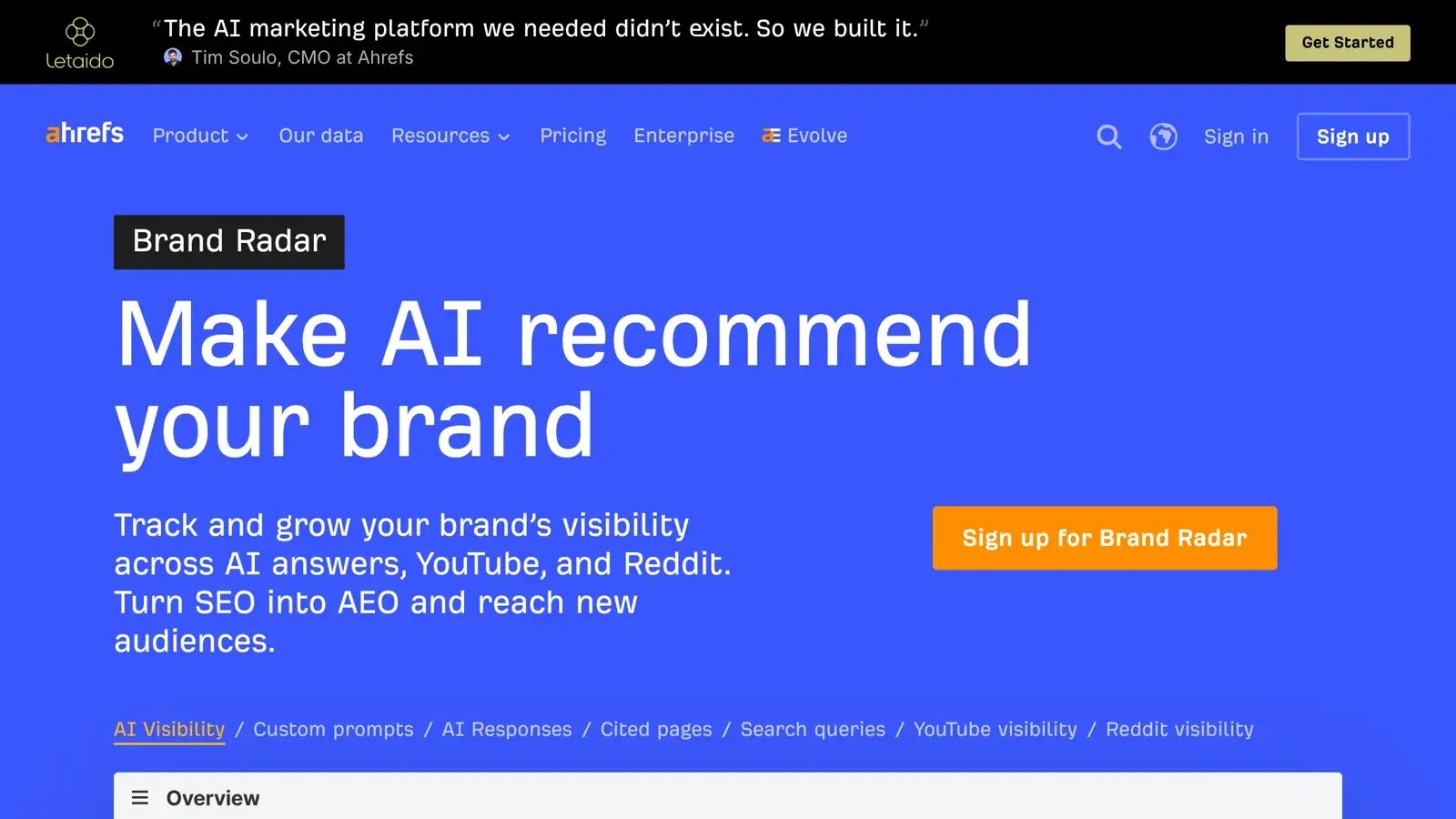
Best for: teams that want to see which buyer questions already surface a competitor, and then track their own questions every day.
What stands out: the prompt database. It holds more than 512 million search-backed prompts, so a healthcare team can see where competitors are already recommended before writing a single question of its own. Brand Radar runs those prompts through Google AI Overviews, Google AI Mode, ChatGPT, Perplexity, Gemini and Copilot and stores every response, so you can always read the sentence behind a score. Custom prompts add Claude, which gives it more engines than any other published plan here. Its Bot Analytics, free while in beta, shows when AI crawlers read your pages and which ones they visit most.
ahrefs.com, captured 2026-09-23
Skip it if: your archive needs every answer dated the day you asked for it. We requested our answers for October 2, 2026, and 2 of the 22 Perplexity answers came back dated September 26. Ahrefs also says the database works best for established brands and may have limited coverage for brands with little or no search volume. A niche device line will lean on custom prompts.
Price and plans: Brand Radar custom prompts start at $50 a month for 150 checks, with plans of 300 and 600 checks and larger plans from 2,500 checks a month, where each prompt is checked daily on every platform you select. The prompt database, sold as the AI Visibility Index, starts at $199 a month, and $699 a month covers all models. There's no free trial.
Healthcare fit: 4/4.
How we use it: Sōvyn runs its AI visibility audits on Ahrefs Enterprise, and we collected the answers for our test with Brand Radar custom prompts.
PromptRush
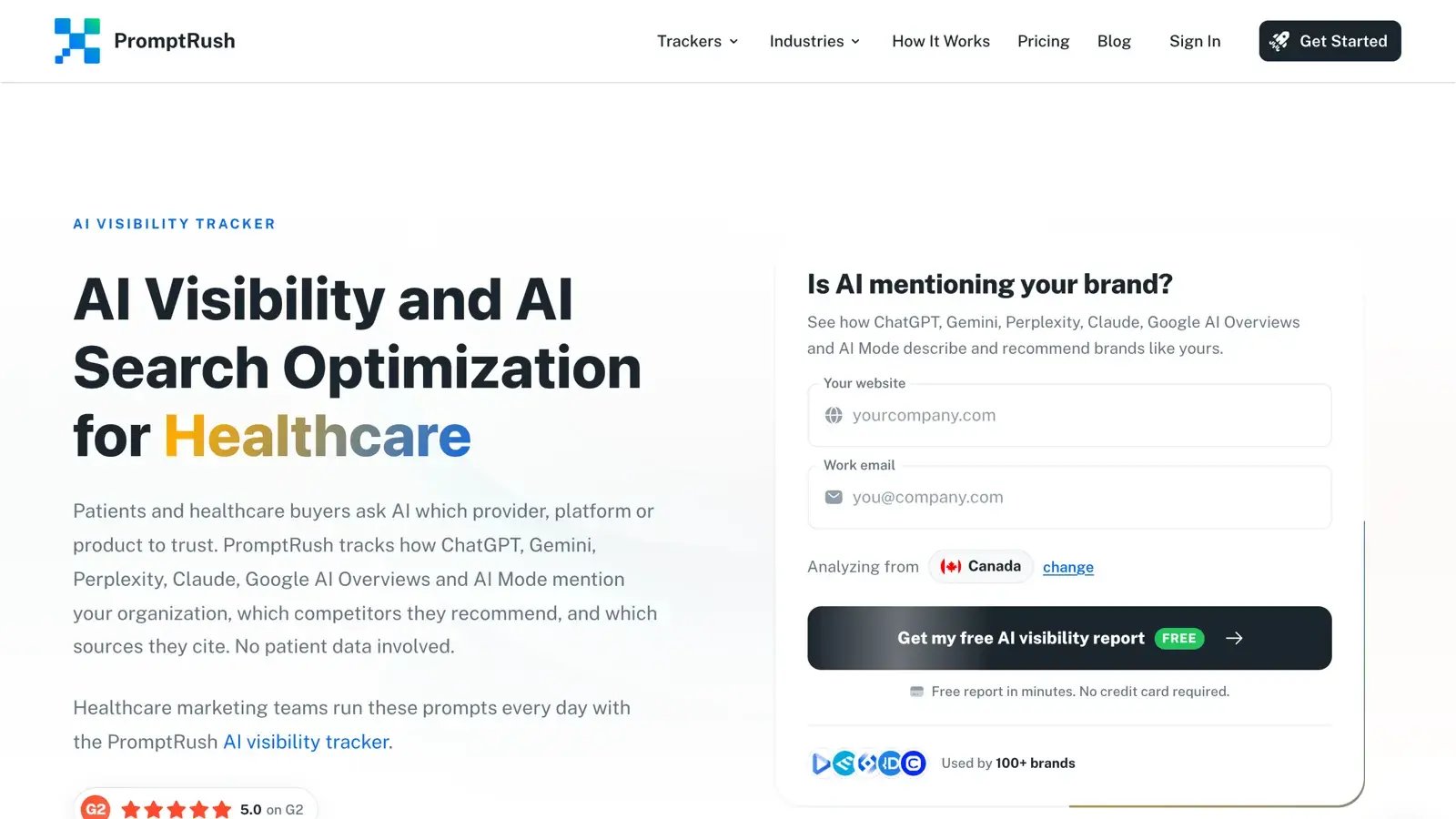
Best for: health systems and providers that want five engines tracked daily on an entry-level budget.
What stands out: it gives you a starting set of healthcare questions. Its healthcare page lists what each type of healthcare brand should track, from "best hospitals for cardiac care in [city]" for health systems to "best telehealth platforms" for health tech, plus the category and comparison questions buyers and clinicians ask about devices. PromptRush says you see the full answer for every prompt, so your team can catch wrong claims about services, eligibility or safety and fix the sources behind them.
promptrush.ai, captured 2026-09-23
Skip it if: you want a vendor with a long review record. PromptRush has 2 reviews on G2, too few for G2 to give buying insight, and one reviewer would like "a more refined source selection on the Prompts page." The entry plan's 25 prompts would also have held our 22-question test with only 3 to spare. A health system with a device line will need Growth, at $99 a month for 150 prompts.
Price and plans: on PromptRush's pricing page, Lite costs $19 a month for 25 prompts. Every plan checks ChatGPT, Gemini, Perplexity, Google AI Overviews and Google AI Mode daily, with a 30-day money-back guarantee. Claude is an add-on from $39 a month. It runs through Anthropic's API, and PromptRush says its results may differ from the claude.ai chat.
Healthcare fit: 4/4.
Finseo
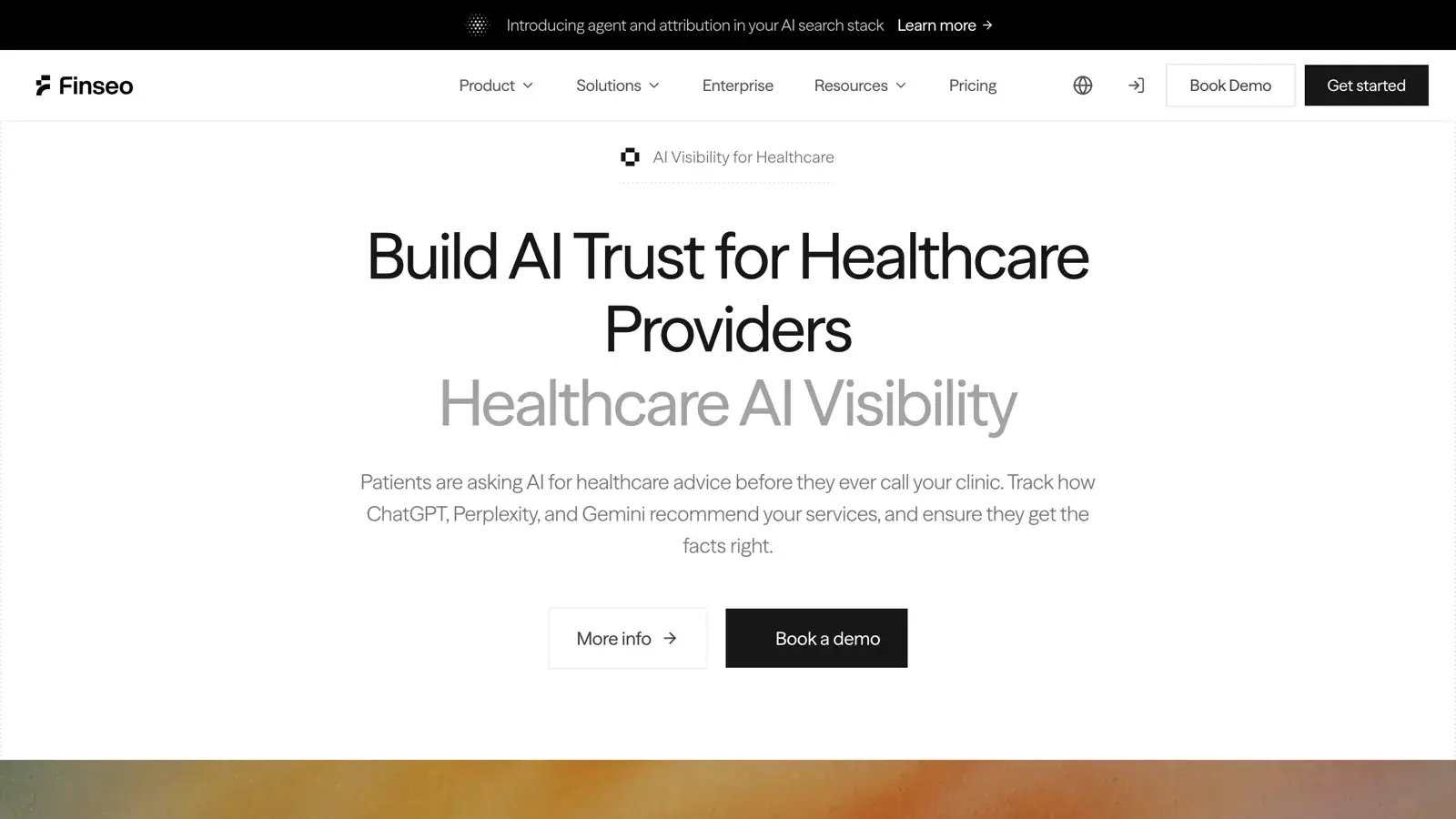
Best for: healthcare providers that want to know whether AI shows their clinical credentials correctly.
What stands out: credential monitoring. Finseo watches how AI platforms display your clinical credentials, so a wrong credential becomes something your team can find and fix. Its daily runs save every answer that names or cites your brand, in every engine you track, and its report builder exports them for your team. Its healthcare page also says plainly, "We monitor public AI responses, not patient data."
finseo.ai, captured 2026-09-23
Skip it if: your team needs documentation to read the results on its own. OMR Reviews' summary of Finseo's user reviews names that as the drawback: many terms are "not self-explanatory," and there are no info buttons to put results in context. G2 lists only 3 reviews. Every plan below Enterprise also tracks 3 engines at a time. Enterprise, priced on request, tracks up to 11.
Price and plans: on Finseo's pricing page, Starter costs €84 a month for 50 prompts on 3 models you choose, including ChatGPT, Google AI Overviews and Google AI Mode, tracked daily or weekly. Prices are in euros and exclude VAT, and Starter's first 7 days are free.
Healthcare fit: 4/4 if ChatGPT and Google are among your three engines.
Peec AI
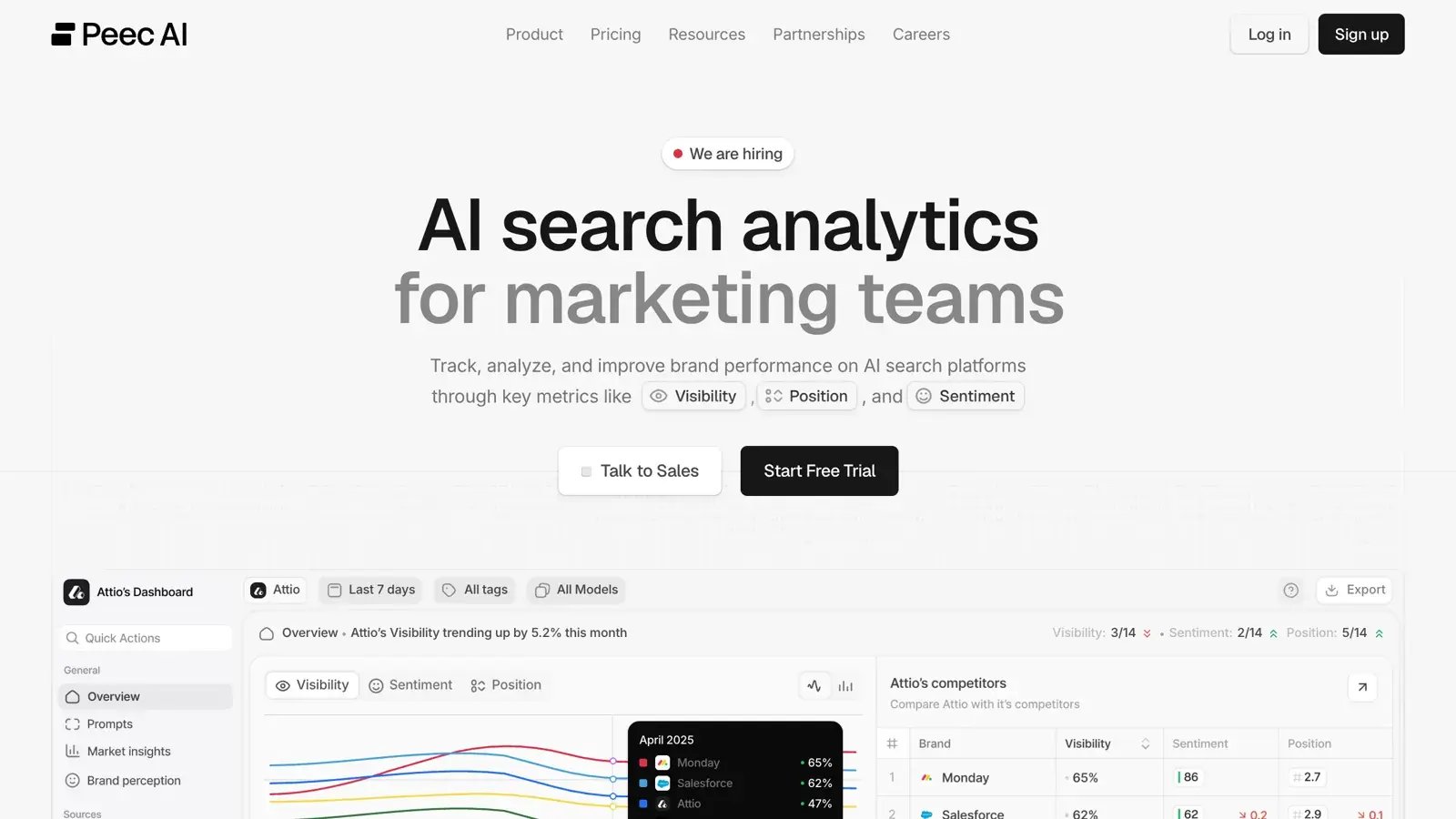
Best for: teams that want to check what AI answers claim about them against facts they set.
What stands out: fact checks, which is the job a healthcare reviewer actually does. Peec AI's pricing page lists fact checks that test tracked answers for claims about your brand against the facts you set. Every plan includes them, Starter too. A mention only helps if the sentence around it is accurate, and this is how you find out. Its documentation says you can open the last 100 chats for each prompt, each with the full AI-generated answer.
peec.ai, captured 2026-09-23
Skip it if: three engines won't cover your buyers. The Answer Engine Report called the three-model cap on every plan below Enterprise its biggest constraint in May 2026, and G2 reviewers find the small number of models per plan "limiting from time to time." Pick ChatGPT, Google AI Overviews and Google AI Mode, and there's no room left for Gemini or Microsoft Copilot.
Price and plans: on Peec AI's pricing page, Starter costs $95 a month for 50 prompts and 1 project, tracked daily, with unlimited users and 3 models you choose. Enterprise tracks up to 13. The page offers a free trial.
Healthcare fit: 4/4 if ChatGPT and Google are among your three engines.
Not sure which engines your buyers use? Sōvyn's free category map shows the vendors ChatGPT, Perplexity and Google's AI name for your category, the sources they cite and where your brand appears. Check it before you pay for any tool. Get the category map
SE Ranking AI Visibility Tracker
Best for: teams already on SE Ranking that want AI answers tracked next to their search rankings, in the same tool.
What stands out: history by engine, which is what a compliance file needs. The Answer Engine Report's May 2026 review lists what the tracker charts over time:
- Citations, engine by engine.
- Brand mentions, with and without a link to your site.
- The outside domains each engine cites most for your category prompts.
That record shows when an engine started citing a source about you, and which source it was. SE Ranking says the tracker captures each response as a real user would see it and keeps cached copies of the answers.
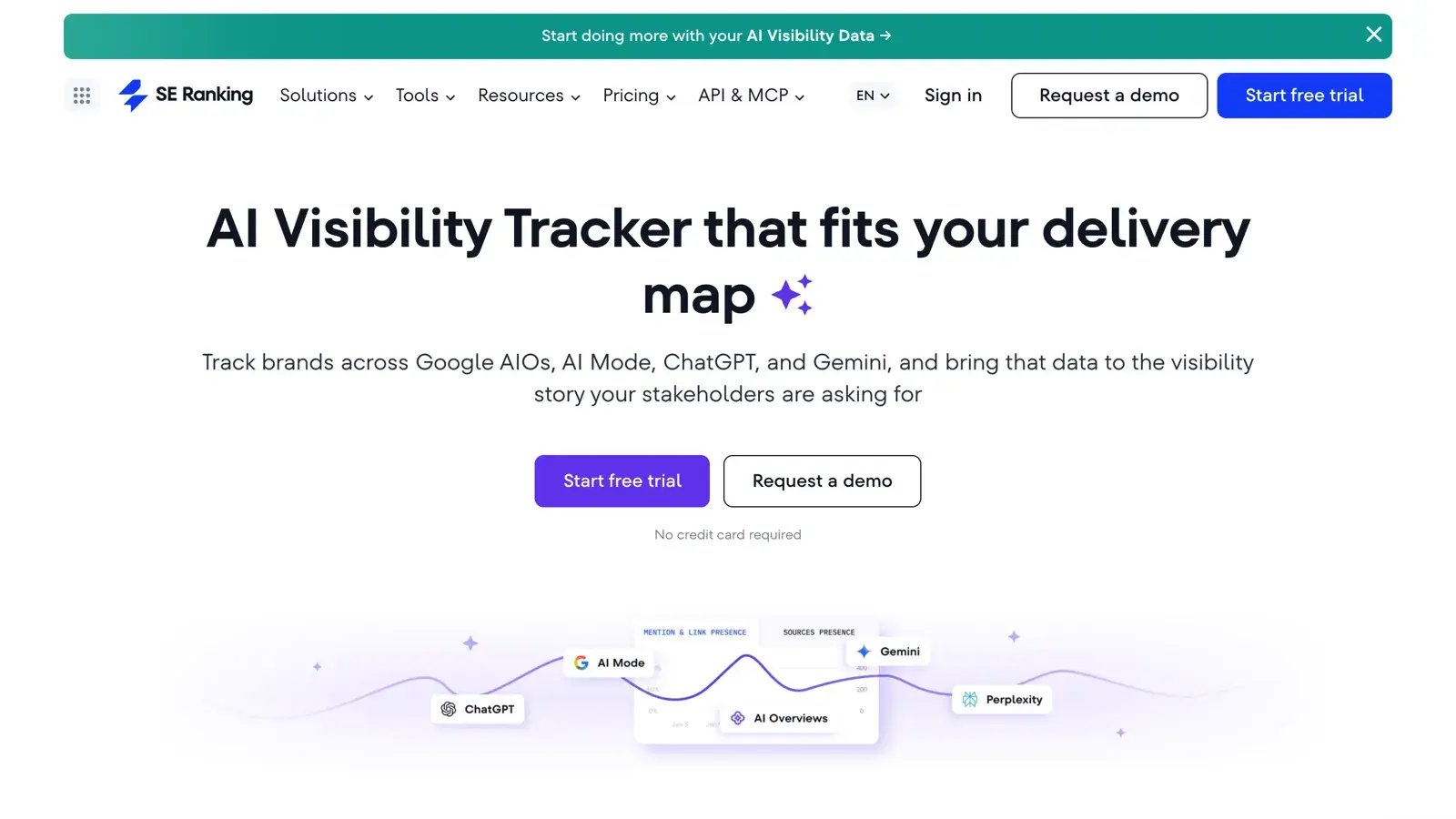
seranking.com, captured 2026-09-23
Skip it if: your buyers use Claude or Copilot. The Answer Engine Report notes that, as of May 2026, it doesn't track Claude, Grok, Microsoft Copilot, DeepSeek or Meta AI.
Price and plans: on SE Ranking's plans page, Core costs $129 a month and tracks 100 prompts daily on 5 LLMs, which The Answer Engine Report lists as ChatGPT, Perplexity, Google AI Overviews, Google AI Mode and Gemini. Growth, at $279 a month, keeps historical data across the project's lifetime, which matters if your compliance file needs more than recent history. Both plans start with a free 14-day trial, no credit card required.
Healthcare fit: 4/4.
Profound
Best for: larger healthcare and pharma teams that want a platform built only for AI answers and can buy an enterprise plan.
What stands out: how your brand is framed. The Answer Engine Report's May 2026 review describes a Conversation Explorer that lets analysts read how a brand was framed in individual answers, which competitors appeared alongside it and which sources the engine cited. Profound also has a pharma page headed "Own your therapeutic area in AI Search," and it has announced HIPAA compliance for healthcare AEO. That matters only if a workflow puts protected health information into the tool.
Skip it if: your team is small. G2 reviewers say "the price can be off-putting at first, especially if you are not a large company" and call it "rather expensive in comparison to other tools we've vetted," while crediting it with "more insights and actionable agents than others." The Answer Engine Report adds that reviewers describe a steep learning curve.
Price and plans: Profound's pricing page offers a free trial of 50 prompts, run daily for 7 days on ChatGPT, Gemini and Google AI Overviews. Seven days of data can't show a trend, though. The history and exports a compliance file needs come with Enterprise, priced on request, which tracks up to 9 answer engines with all-time history and CSV and JSON exports.
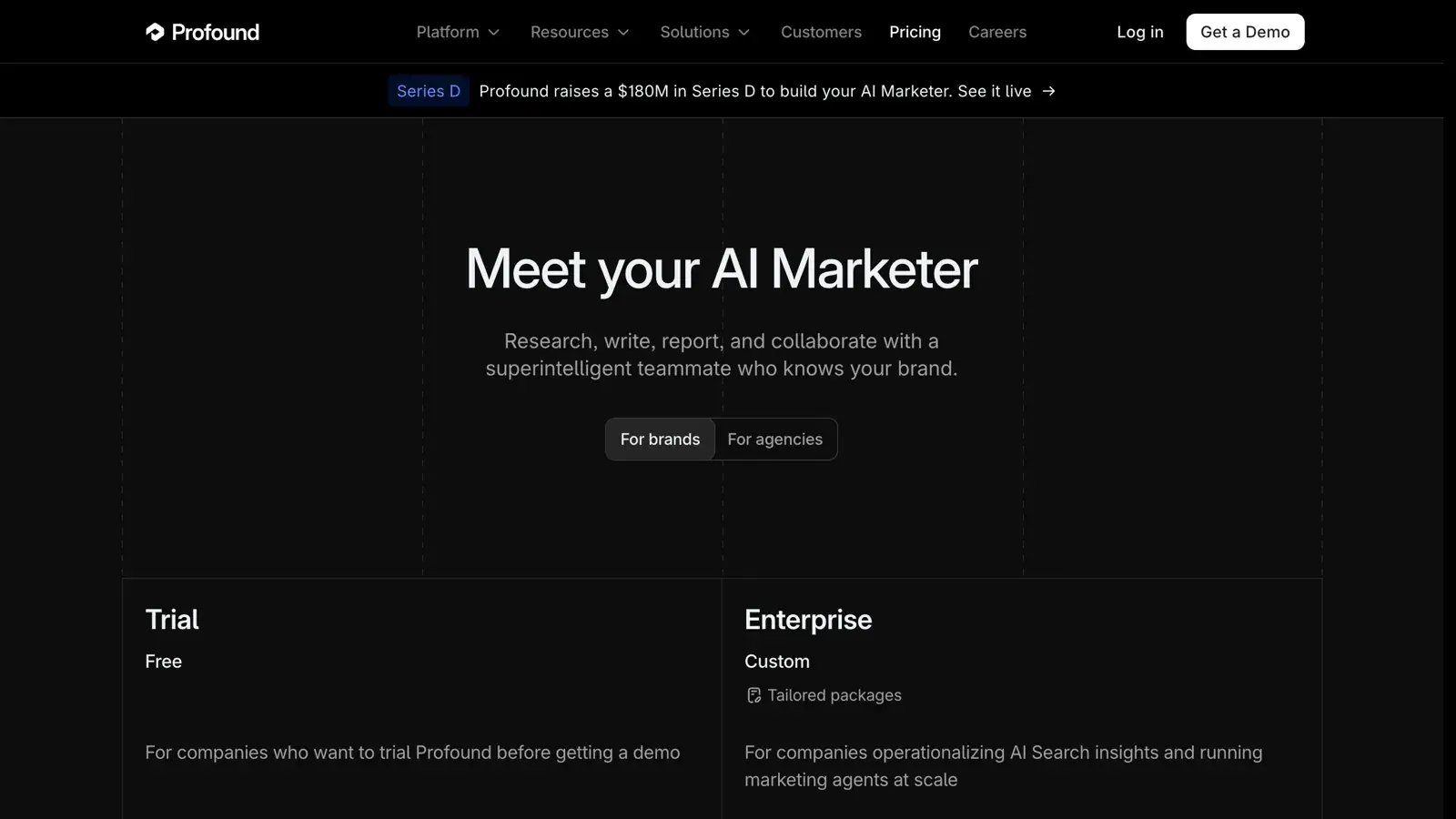
tryprofound.com, captured 2026-09-23
Healthcare fit: 3/4 (no published price for brand plans).
Semrush AI Visibility Toolkit
Best for: teams whose SEO work already runs in Semrush.
What stands out: how AI describes your providers. Semrush's healthcare page promises to track what ChatGPT and Gemini say about your health system when patients ask for provider recommendations, and to compare that with what they say about competitors. It also sits in a suite your SEO team may already use.
Skip it if: you track more than one segment. The price covers one domain and 25 prompts, about one segment's worth: our test used 22 questions for health tech buyers alone. 99signals' review notes that an upgrade raises the prompt cap only, not the price of extra domains. Ask what the next domain costs, and whether the Toolkit stores the answer behind each ranking.
Price and plans: on Semrush's pricing page, the AI Visibility Toolkit's Base plan costs $99 a month per domain, billed annually. It includes 25 custom prompts with daily AI rankings, Brand Performance analysis for one domain, and mentions from ChatGPT, Google AI (Semrush's label), Gemini and Perplexity. Semrush offers a seven-day free trial.
Healthcare fit: 3/4 (answer text not confirmed).
Scrunch
Best for: teams that want prompt tracking with AI bot traffic included.
What stands out: the bot side. AI bot traffic shows whether the engines can actually reach the service and claims pages you've approved. Scrunch reports it on its Core plan, and a G2 reviewer notes that AI bot crawler tracking is included at no extra cost. Core also tracks 5 competitors, with sentiment analysis.
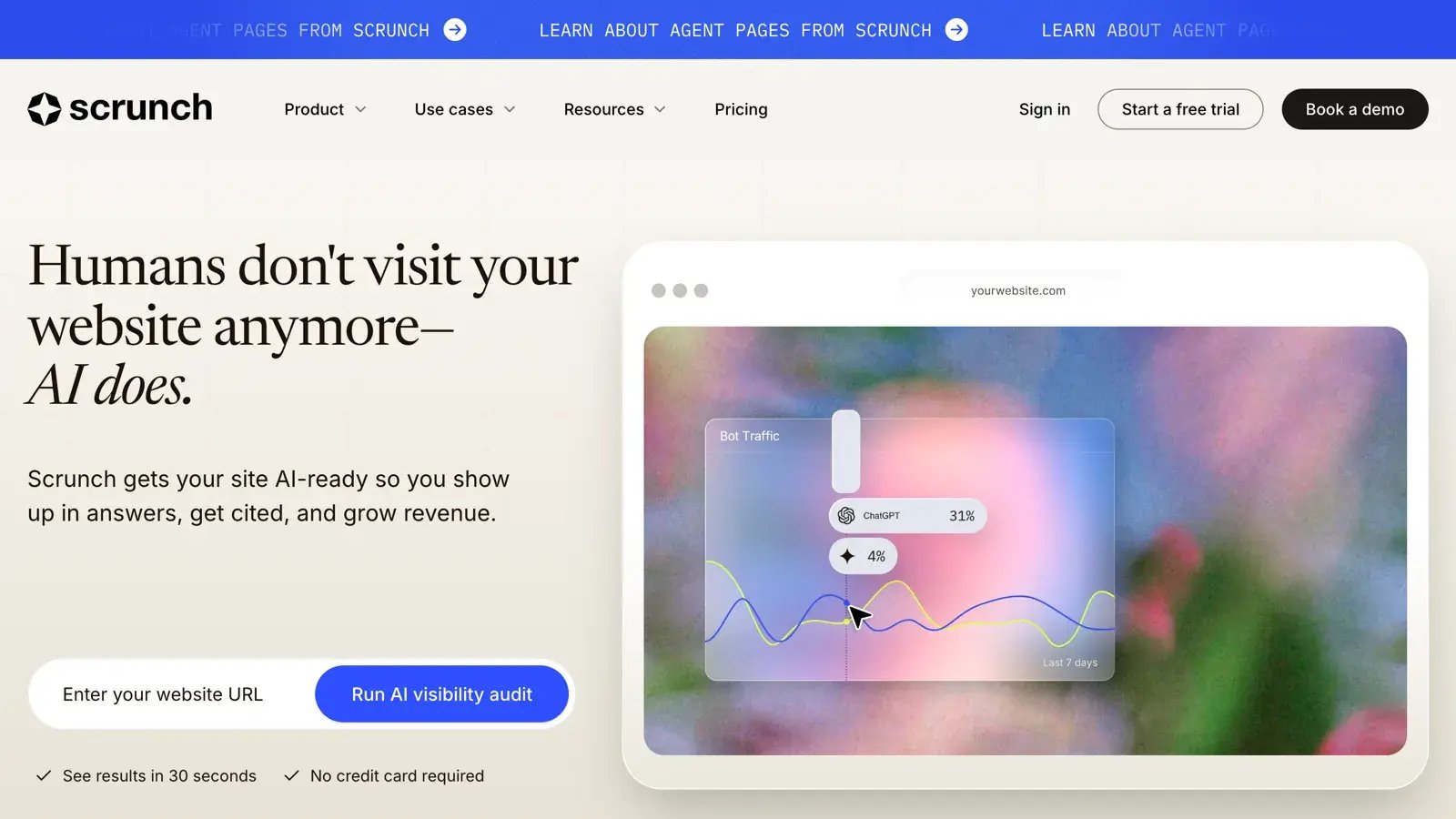
scrunchai.com, captured 2026-09-23
Skip it if: you want raw numbers. A G2 reviewer would "like to see more ways to show raw mentions metrics on the dashboard and less as percentages." The pricing page also names no tracking schedule, so ask how often each prompt runs and how far back the saved answers go.
Price and plans: the Core plan on Scrunch's pricing page covers ChatGPT, Perplexity, Google AI Overviews and Copilot, with 125 prompts and 5,000 responses a month for $250 and a 7-day free trial. Gemini, Google AI Mode, Claude, Meta AI and Grok come with Enterprise, priced on request.
Healthcare fit: 3/4 (no published tracking history).
Which AI Visibility Tool Fits Your Healthcare Team?
Start with the questions your buyers ask. Then pick the tool that tracks those questions on the engines your buyers use. The questions differ by segment, which is why one tool can suit a health system and miss for a device company.
| Your team | What your buyers ask | Start with | Why |
|---|---|---|---|
| Health system or provider | A specialty in a city, such as "best hospitals for cardiac care in [city]" | PromptRush or Finseo | Segment prompts from the start; Finseo adds a check on how AI shows your clinical credentials |
| Health tech company | Comparisons, such as "best telehealth platforms" | Ahrefs Brand Radar | Its prompt database shows which buyer questions already name a competitor, before you track your own |
| Medical device company | Category and comparison questions, from buyers and clinicians | PromptRush, Profound or Ahrefs Brand Radar | A device claim is what compliance reviews, so you need the full answer with its date |
| Team already on SE Ranking or Semrush | Whatever you track there today | That suite's AI tracker | AI answers next to your rankings, in one place |
Four questions in a demo will settle most of this:
- Can you export one dated answer, per engine, for a prompt we choose?
- Which engines are on the plan we would buy, not the enterprise plan?
- How far back does the answer history go, and can we keep it if we leave?
- Is the price per domain, per prompt or per check, and what happens at the limit?
Whichever tool you pick, the routine that protects a healthcare brand is the same, and it's simple. Agree on your questions as a team before you track anything. Read the answers, not just the scores. Save every answer with its date.

Then ask the same questions next month, on the same engines. That's what turns a folder of screenshots into evidence. Our guide to improving AI visibility covers what to change between runs. For the program around it, start with building a GEO program.
Before you pick a tool, see where your brand stands today. Sōvyn's free AI visibility category map names the vendors each engine recommends in your category and shows your own position, even if you're not there yet. That gives your first run in any tool a baseline to beat.
AI Visibility Results for 22 Health Tech Prompts
Here are all 22 questions from our test. For each one, the table shows the vendors all three engines named, and how many vendors only one engine named. Read down the second column and you'll see how rarely the three agreed. On most questions, no vendor made all three answers.
- On the 21 questions where both ChatGPT and Google AI Overviews named vendors, the two named 250 vendors between them, counting each vendor once per question. 171 of those came from only one of the two.
- ChatGPT named vendors in 21 of its 22 answers, Google AI Overviews in all 22 and Perplexity in 11.
- All three engines named at least one of the same vendors on 9 of the 22 questions. They put the same vendor first on just 1: for "best EHR systems for healthcare organizations," all three named Epic first.
| Prompt | Named by all three engines | Named by one engine / all named | Note |
|---|---|---|---|
| best EHR systems for healthcare organizations | Epic, Oracle Health, MEDITECH, athenahealth, eClinicalWorks | 5 of 11 | |
| best behavioral health software platforms | ICANotes, Behave Health | 11 of 17 | Perplexity answer dated September 26, 2026 |
| best care coordination platforms | None | 8 of 11 | Perplexity off topic |
| best care management platforms | Salesforce, Epic | 18 of 25 | |
| best clinical decision support systems | Wolters Kluwer | 6 of 12 | |
| best clinical trial management software | Veeva Systems, Medidata, Advarra | 4 of 10 | |
| best digital therapeutics companies | None | 6 of 11 | Perplexity named no vendor |
| best health insurance technology companies | None | 14 of 16 | |
| best healthcare data platforms | None | 10 of 14 | Perplexity off topic |
| best healthcare interoperability platforms | None | 5 of 8 | Perplexity off topic |
| best healthcare technology companies | None | 22 of 22 | Perplexity named no vendor |
| best medical billing companies | None | 10 of 14 | |
| best medical imaging software vendors | None | 7 of 13 | Perplexity named no vendor |
| best medical practice management software | None | 5 of 8 | Perplexity off topic |
| best patient engagement platforms | Luma Health, Phreesia, Klara | 11 of 19 | |
| best patient scheduling software | SimplePractice | 5 of 10 | |
| best pharmacy technology vendors | McKesson | 6 of 8 | |
| best population health management platforms | None | 5 of 9 | Perplexity off topic |
| best provider data management platforms | None | 6 of 6 | ChatGPT asked a question back; Perplexity off topic |
| best remote patient monitoring companies | HealthSnap, Health Recovery Solutions, Optimize Health, CareSimple | 11 of 18 | |
| best revenue cycle management vendors | None | 14 of 17 | Perplexity off topic; Perplexity answer dated September 26, 2026 |
| best telehealth platforms for providers | None | 7 of 10 | Perplexity named no vendor |
Each vendor counts once per prompt. In the third column, the first number is the vendors only one of the three engines named, and the second is every vendor any engine named.
Frequently Asked Questions
Can One Tool Cover a Health System and a Device Line?
Yes, as two separate prompt sets in one account. Keep them apart. A hospital's buyers ask for a specialty in a city, and a device's buyers ask category questions, so one blended share of voice would hide both.
What Goes in an AI Visibility Compliance Report?
Four things, filed together. Start with the prompt list your team agreed on and one dated answer per engine for each prompt. Add the approved-claims sheet you checked each answer against. Then list the claims that need a fix, with the source the engine cited for each. Keep the file under the same retention rule you apply to other reviewed marketing material.
Is a Free AI Visibility Checker Enough?
It's enough to see whether you show up today. But a one-off check keeps no dated history, so it can't show a change. PromptRush's free checker is a reasonable first look, and SE Ranking gives you 5 free checks a day. For a daily history, PromptRush's Lite plan at $19 a month is the lowest published price in this guide.
Do AI Visibility Tools Need to Be HIPAA Compliant?
It depends on two things: who you are, and what goes into the tool.
HIPAA applies to covered entities and their business associates. HHS lists covered entities as health plans, health care clearinghouses and health care providers who transmit health information in electronic form in connection with a covered transaction. HHS describes a business associate as a person a covered entity engages for certain functions or services that involve the use or disclosure of protected health information (PHI).
If your organization is one of those, the question is whether the tool would create, receive, maintain or transmit PHI for you. Visibility tracking runs on prompts you write and answers the engines publish. If no PHI goes into the tool, the vendor isn't handling PHI on your behalf. If a workflow would put PHI into the tool, get a business associate agreement (BAA) with the vendor first.
On the vendors' side, PromptRush says it doesn't access, store or process protected health information. Finseo says it monitors public AI responses, not patient data. Profound has announced HIPAA compliance for healthcare AEO.
What This Means for Your Team
AI engines don't agree on who to recommend, and their answers change over time. That's not a reason to ignore them. It's a reason to measure them the way a regulated team measures anything else: the same questions, on the engines your buyers use, with every answer saved and dated.
Any of the five tools that pass all four checks can do that. The real difference comes from what you do with the record: correcting the claims engines get wrong, and earning a place in the answers where competitors show up today.
References
- Sōvyn, AI visibility prompt run: 22 health tech prompts on ChatGPT, Google AI Overviews and Perplexity, answers dated October 2, 2026, collected with Ahrefs Brand Radar. The table above
- SparkToro, Rand Fishkin, AIs are highly inconsistent when recommending brands or products, January 2026. sparktoro.com
- Semrush, Semrush releases expanded 2026 AI Visibility Index analyzing 126 million AI search prompts. semrush.com/news
- Pew Research Center, From diagnoses to treatments: why Americans use AI chatbots for health, August 2026. pewresearch.org
- KFF (Kaiser Family Foundation), Poll: 1 in 3 adults are turning to AI chatbots for health information, March 2026. kff.org
- OpenAI, AI as a Healthcare Ally, January 2026. cdn.openai.com
- Ahrefs, Brand Radar, and Plans and pricing, read October 2026. ahrefs.com/brand-radar and ahrefs.com/pricing
- PromptRush, AI Visibility for Healthcare, and Pricing, read October 2026. promptrush.ai/industries/healthcare and promptrush.ai/pricing
- Finseo, AI Visibility for Healthcare, Pricing, and AI Visibility Tracking, read October 2026. finseo.ai/solution/healthcare, finseo.ai/pricing and finseo.ai/ai-visibility-tracking
- Peec AI, home page, Pricing, and Understanding chats, read October 2026. peec.ai, peec.ai/pricing and docs.peec.ai
- SE Ranking, AI Visibility Tracker, and Pricing, read October 2026. seranking.com/ai-visibility-tracker and seranking.com/subscription
- Profound, Pricing, read October 2026; AI Search for Pharmaceuticals; and Profound achieves HIPAA compliance for healthcare AEO. tryprofound.com/pricing, tryprofound.com/solutions/pharma and tryprofound.com/blog
- Semrush, AI Visibility Toolkit pricing, read October 2026, and Semrush for healthcare. semrush.com/pricing/ai and semrush.com/solutions/healthcare
- Scrunch, Pricing, read October 2026, home page, and How to add prompts in Scrunch. scrunch.com/pricing, Scrunch home page and Scrunch help center
- The Answer Engine Report, reviews of SE Ranking, Peec AI and Profound, May 2026. SE Ranking, Peec AI and Profound
- G2, reviews of PromptRush, Finseo, Peec AI, Profound and Scrunch, read October 2026. PromptRush, Finseo, Peec AI, Profound and Scrunch
- OMR Reviews, Finseo reviews and features, read October 2026. omr.com
- 99signals, Semrush AI Visibility Toolkit Review: Does It Deliver? 99signals.com
- U.S. Department of Health and Human Services (HHS), Business Associates Frequently Asked Questions, last reviewed October 21, 2026. hhs.gov
Disclosure: Sōvyn uses Ahrefs, and this is not a sponsored post. We're not in a partner program with any of these vendors.


Ulf Lonegren is Executive Director of AI at Sōvyn, where he builds the AI-orchestrated systems behind the agency's SEO and answer engine optimization work. He co-founded Roketto in 2009, the B2B growth agency now part of Sōvyn, and has spent more than 16 years helping B2B technology companies build pipeline that compounds instead of resetting every quarter. His focus is the seam where search is changing: how content earns citations inside AI answers rather than only rankings on a results page, and what has to be true operationally for a team to produce that kind of content repeatedly. He writes about answer engine optimization, AI visibility, and the difference between running tactics and running a system.
Less Scrolling.
More Knowing.
Subscribe to our newsletter for quick snippets of news & trends in health, life sciences, and tech marketing & PR.




Share blog


